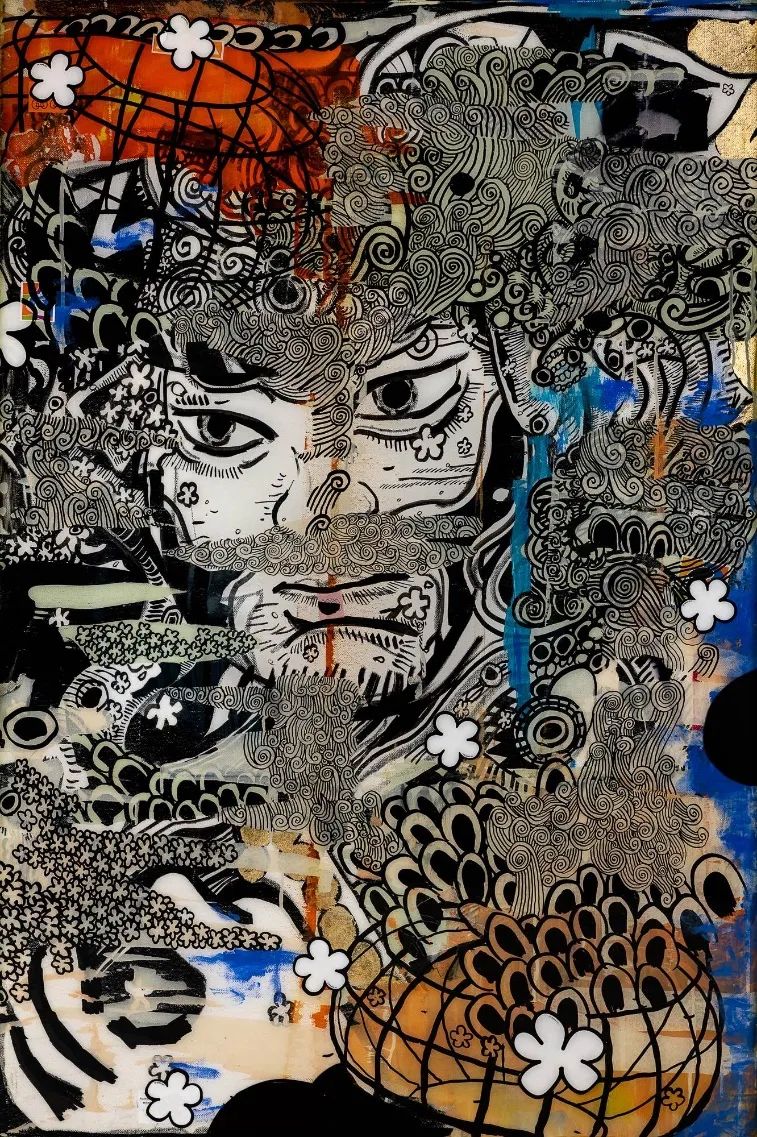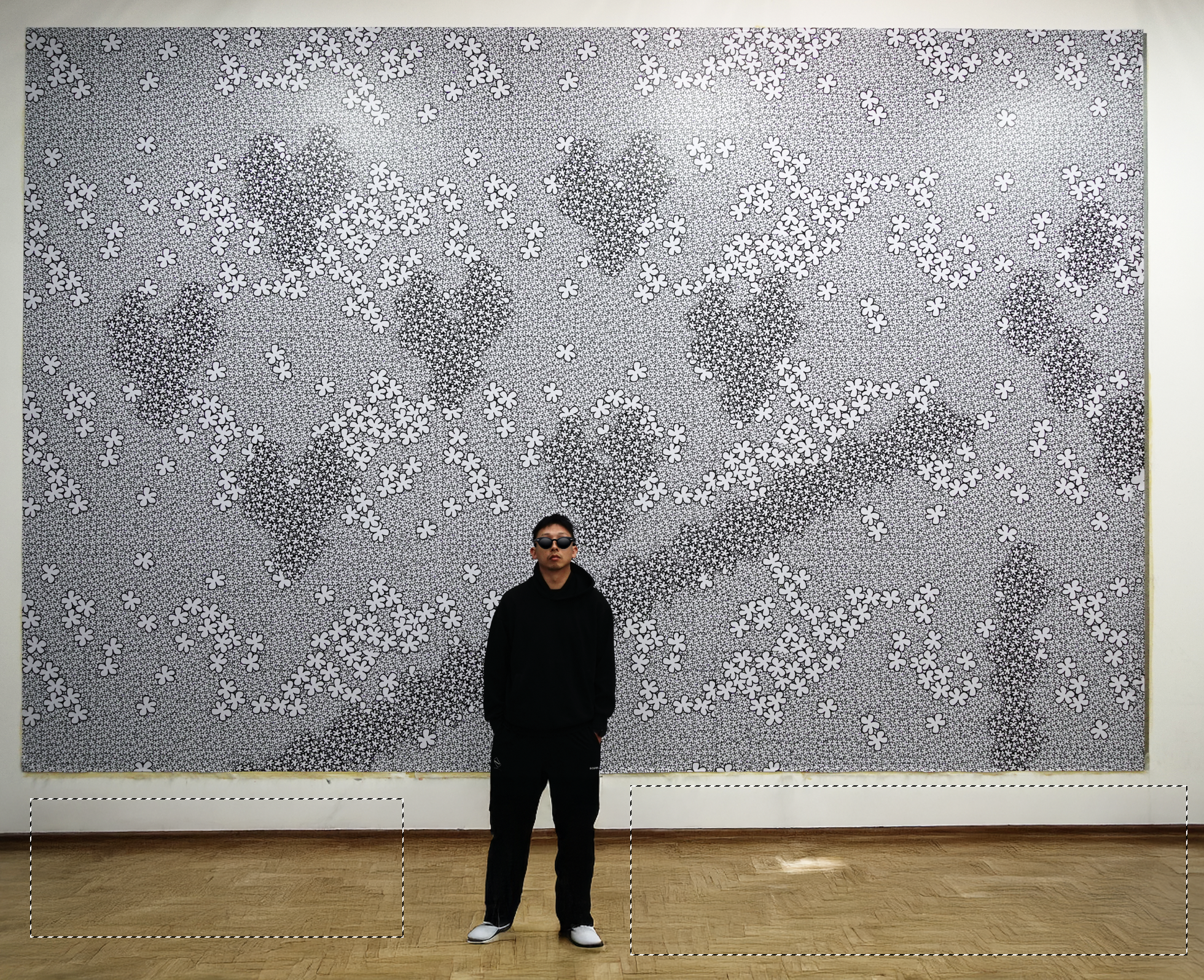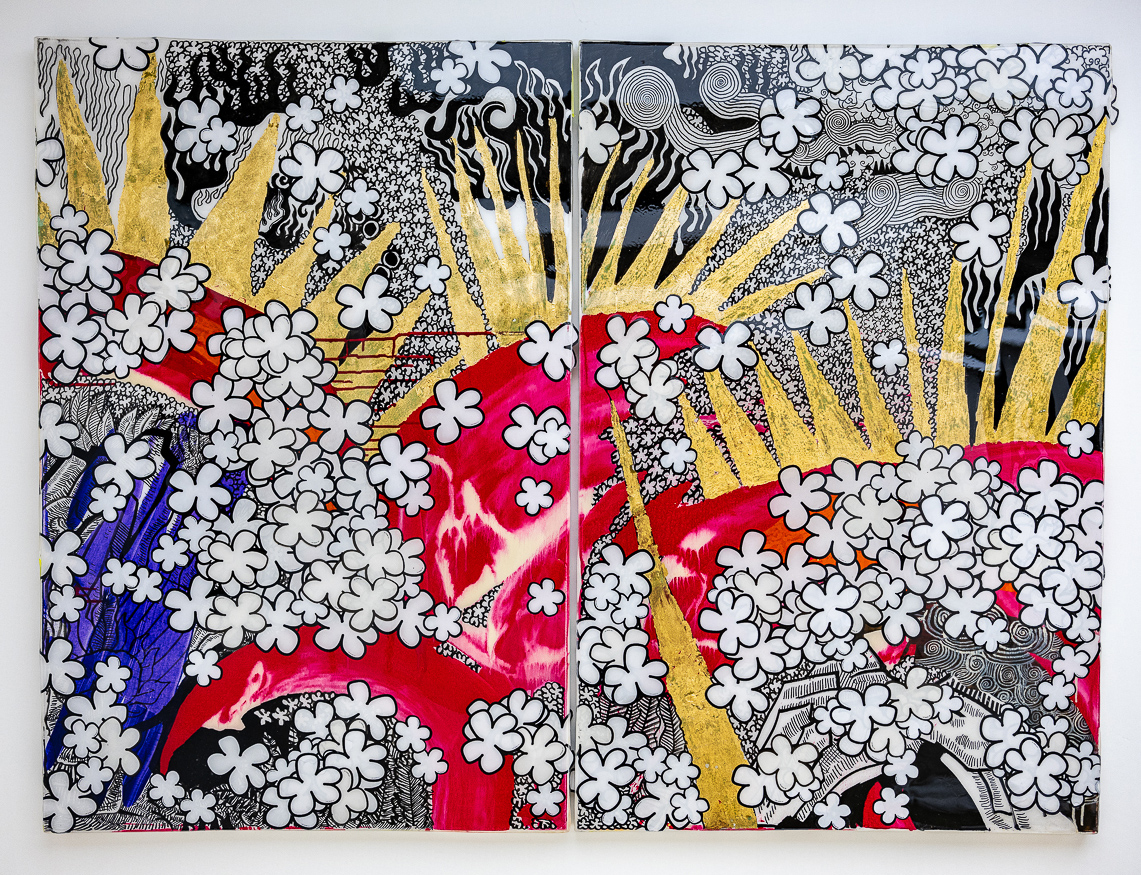

Lve Wang 的 Dream Cells / 梦的细胞 不应被理解为一组私人化的装饰性花卉符号,也不只是艺术家反复使用的个人图像母题。它真正的力量不在这里。通过绘画、贴纸、树脂、金箔、铜箔、线条、擦除与层层积累,Dream Cells 提出了一种图像生成方式:文化记忆并不是被保存为档案,而是被建构为表面。 这个区别很重要。档案意味着秩序、分类与机构保护;表面意味着暴露:它会被触碰、覆盖、损坏、修复、再次书写,并在新的光线下重新被看见。Lve Wang 的创作正是从这种暴露状态开始。他的图像并不只是再现记忆,而是像记忆本身一样运作:它们经过城市墙面、数字信息流、街头标记、童年回忆、神话碎片,以及符号不稳定的后续生命,最终沉积为一层不断变化的视觉表皮。
在图像过剩的时代,图像很少有机会真正老去。它们被生产、消费、转发、替换,速度快到几乎来不及形成深度。当代图像被迫追求即时可读性:它必须立刻被识别、被分享、被吸收。Dream Cells 与这种节奏相反。它强调缓慢、重复与沉积。那些花卉形态初看简单,甚至带有儿童绘画般的天真感,但它们从来不只是纯真的图案。重复让它们产生重量,层叠让它们获得时间感,树脂把它们悬置在保存与困住之间,金箔和铜箔引入神圣价值的残光,同时也暗示脆弱、氧化与历史残留。贴纸原本常与涂鸦文化、街头传播和临时性视觉信息相关,在这里却成为记忆的载体,而不是一次性图像垃圾。最终形成的不是一个装饰系统,而是一片承受压力的视觉场。
Dream Cells 这个名称之所以有效,正因为它没有描述一个完成的图腾。Cell 是生命的基本单位,也可以是容器、隔间、结构,是能够分裂与变异的组织;Dream 则是不稳定的、联想性的,拒绝线性历史。两者结合,指向一种视觉有机体:它通过重复生长,携带过去形态的痕迹,并持续向新的转化开放。因此,Lve Wang 的花卉符号与其说是等待被解码的象征,不如说是累积单位。它们收集时间,承载损伤,吸收周围材料,并成为一种思考文化记忆如何存活的方式:当记忆不再由单一传统、媒介或机构承载时,它会以何种形态继续存在?
因此,不能把 Dream Cells 简化为「东方美学」。这种说法容易把创作压缩成一种可消费的文化氛围。Lve Wang 确实与中国视觉传统有关:花鸟画的细腻、山水画中的留白与气韵、东方神话结构,以及仪式与装饰中的象征系统,都是他的创作资源。但他的作品不是对传统的回归,而是在处理传统被碎片化之后的状态。Dream Cells 中的花卉符号并不是作为稳定的文化遗产标识出现。它已经从原有语境中松动,被简化、重复、粘贴、覆盖,并嵌入新的材料关系之中。它成为传统的残留,而不是传统本身。从这个意义上说,Lve Wang 的创作更接近考古,而不是怀旧。他不是修复过去,而是处理过去被城市生活、商业图像文化、数字流通和个人记忆不断碰撞之后留下的残片。
表面,是这个创作系统的核心现场。在 Lve Wang 的作品中,表面从来不是被动的。它不是图像附着其上的中性底板,而是不同时间发生碰撞的活性区域。丙烯带来手势与即时性,贴纸带来街头传播与重复逻辑,树脂冻结或封存图像,同时制造保护与距离,金属箔产生闪光,使人联想到神圣器物、奢华表面和历史装饰,但也暴露出价值的不稳定。这些材料不是简单共存,而是在彼此拉扯。贴纸想要流通,树脂想要保存;线条想要运动,金箔想要静止;花卉符号想要保持天真,积累的表面却引入压力、密度与疲惫。正是通过这些矛盾,Lve Wang 把艺术作品转化为一层活的皮肤。
这层活的皮肤与城市有关。涂鸦和贴纸文化的重要性,不在于它们为 Lve Wang 提供了一种视觉风格,而在于它们提供了一种关于记忆的理论。城市中的墙面从来不是空白的。它会被书写、被涂掉、被贴上广告、被清洗、被损坏、被修补,然后再次被标记。它记录着公共表达、私人财产、城市管理、商业信息和匿名存在之间的冲突。墙面是一种社会表面。它并不干净地保存记忆,而是通过干扰来保存记忆。Lve Wang 的作品正是从这种逻辑中获得力量。他的层叠构图并不只是因为艺术家喜欢视觉丰盛,而是因为当代城市生活中的记忆本来就是密集的。记忆以中断、重叠和局部可见的方式出现。总有某些东西存在于可见层之下,但那个底层永远无法被完整取回。
这也使 Dream Cells 特别适合回应当下的图像过剩状态。数字文化制造了一个无尽的现在:图像没有历史地出现,脱离语境地流通,并以碎片形式被快速消费。与之相反,Lve Wang 的作品提出另一种时间性:如果图像不是被替换,而是被允许积累,会发生什么?如果一个符号不断重复,直到它不再是 logo、插图或装饰母题,而成为一种坚持的痕迹,它会生成什么样的记忆?在这里,花卉细胞成为生存的索引。它一次次返回,不是作为品牌标识,而是作为小规模的持续存在。在一个崇尚新鲜感的文化中,重复可以成为一种批评。它拒绝不断制造新图像的要求,转而追问:当同一个图像被时间施压之后,它会如何改变?
Lve Wang 花卉符号中的儿童感也必须被谨慎理解。儿童般的线条常被误认为简单,但在 Dream Cells 中,它带有双重力量。一方面,它指向童年记忆、花园经验,以及人在接受学院训练之前对标记的本能冲动;另一方面,当这种线条被置入复杂材料表面之中,它就不再只是感伤。纯真没有被完整保存。它被树脂、金属碎片、颜料层与视觉噪音包围。儿童般的线条变得脆弱,但也因此变得坚韧。它在不断覆盖与重塑的系统中存活下来。脆弱与持久之间的张力,是 Lve Wang 创作中最有力的部分之一。他的作品并不宣称记忆可以保持纯粹,而是提示我们:记忆正是通过不断改变形态而存活。
金属箔的使用进一步复杂化了这种关系。金在历史上与神圣光辉、皇权价值、宗教表面和奢侈展示密切相关。在 Lve Wang 的作品中,金箔并不只是美化图像。它引入了关于价值的问题:什么正在被神圣化?什么正在被保护?什么东西在被重复、损伤或几乎失去之后,反而变得珍贵?当金箔与贴纸、涂鸦式标记同时出现时,它制造了一种有效的不稳定。街头材料与神圣材料占据同一个画面。非正式的东西与仪式性的东西被压缩进同一层表面。这并不是装饰性的混搭,而是在记录当代文化中不断混杂的价值系统:一次性的与神圣的、病毒式传播的与仪式性的、商业的与亲密的。
树脂则扮演另一种角色。它让表面变得光滑、诱人、被封存,但同时也制造距离。它保存,同时也困住;它保护,同时也让触摸变得不可能。从这个意义上说,树脂成为当代记忆的隐喻。我们通过屏幕、云端、档案和平台保存图像,但这种保存往往伴随着与真实经验的分离。记忆可以被保存,却仍然变得不可触碰。Lve Wang 的树脂层让这个悖论可见。观看者可以看到深度,却无法进入深度。表面同时提供通道与拒绝。
Dream Cells 也让 Lve Wang 的作品超越了个人传记。虽然这套系统可能从个人记忆开始,但它并不停留在私人层面。它的结构是集体性的。反复出现的细胞暗示,个人记忆始终是更大文化有机体的一部分。童年花园、城市墙面、神话碎片、涂鸦标签和数字图像信息流,并不是彼此分离的世界,而是符号穿行其间的不同环境。Lve Wang 的作品之所以有说服力,正是在于他让这些环境相互污染。梦并不是对现实的逃离,而是文化残片重新组织自身的地方。
由此,Lve Wang 的创作可以被放进更广泛的当代讨论之中。今天,许多艺术家都在回应图像饱和、文化碎片化与历史记忆的不稳定。有些人转向档案方法,有些人转向数字模拟,有些人转向制度批评。Lve Wang 的回应则是材料性的,也是象征性的。他并不拒绝图像,而是让图像慢下来。他让图像经受触摸、重复、覆盖和材料后果。他的作品提示我们:当代图像的问题不只是图像太多,而是太少图像有机会随着时间累积意义。Dream Cells 因此成为一个反向系统:一种让图像重新变厚的方法。
Lve Wang 创作中的风险,是被审美化。因为作品具有视觉吸引力,花卉符号、金色表面、树脂深度和梦境般的标题,都可能让其中的批评压力被忽略。如果缺乏严谨框架,它很容易被读成装饰性的、疗愈性的,甚至是适合商业空间的视觉语言。更强的阅读方式必须更严格:这些作品并不只是关于疗愈,而是关于疗愈需要经过什么。它需要面对受损的表面,重复进行重建,并接受记忆永远无法恢复到原初状态。在这个意义上,更新不是安慰,而是断裂之后的重新组织。梦并不柔软。梦是一种处理无法被干净记住之物的结构。
因此,Dream Cells 未来的强度,取决于 Lve Wang 能否更清楚地把这套系统连接到具体的历史、城市与文化条件。这个实践已经具备必要的材料:街头表面、符号重复、东方图像记忆、数字延展、公共参与,以及将脆弱符号转化为密集视觉场的能力。它必须避免的,是变成一个封闭的个人神话。神话之所以有力量,是因为它能解释创造者之外的世界。Dream Cells 最有说服力的时刻,是当它触及一种共同处境:当图像移动得太快,表面不断被覆盖,继承而来的符号从原有语境中脱离时,文化记忆如何继续保留下来?
从这个角度看,Lve Wang 的作品不是一个个人符号的发明,而是在图像过剩时代建立一套文化记忆系统。它的花不是花,而是视觉持续存在的细胞;它的层次不是装饰,而是压力的记录;它的表面不是背景,而是时间、损伤、价值与回忆不断积累的活性皮肤。在 Dream Cells 中,记忆不是被放在玻璃之后,成为完成的遗物。它是暴露的、被标记的、被封存的、被重新打开的,并且再次生长。


Dream Cells and the Living Surface of Cultural Memory
Lve Wang’s Dream Cells should not be understood as a private lexicon of decorative floral signs, nor as an artist’s repeated motif in the conventional sense. Its force lies elsewhere. Across painting, stickers, resin, gold leaf, copper leaf, line, erasure and accumulation, Dream Cells proposes a model of image-making in which cultural memory is not preserved as archive, but built as surface. This distinction matters. An archive implies order, classification and institutional protection. A surface implies exposure: it is touched, overwritten, damaged, covered, repaired, circulated and seen again under new light. Wang’s work begins from this condition of exposure. His images do not simply represent memory; they behave like memory after it has been passed through urban walls, digital feeds, street markings, childhood recollections, mythological fragments and the unstable afterlife of signs.
In an age of visual excess, images are rarely allowed to age. They are produced, consumed, reposted and replaced with such speed that they often fail to develop depth. The contemporary image is pressured toward instant legibility. It must be recognizable, shareable and quickly absorbed. Wang’s Dream Cells move against this rhythm. They insist on slowness, repetition and sedimentation. Their floral forms appear simple at first, even childlike, but they are never merely innocent. Repetition gives them weight. Layering gives them duration. Resin suspends them in a state between preservation and entrapment. Gold leaf and copper leaf introduce traces of sacred value, but also of fragility, oxidation and historical residue. Stickers, often associated with graffiti culture, street promotion and informal circulation, become carriers of memory rather than disposable graphic debris. The result is a visual system that treats the image as a field of pressure.
The term Dream Cells is useful precisely because it does not describe a finished icon. A cell is a unit of life, but also a container, a compartment, a structure capable of division and mutation. A dream is unstable, associative and resistant to linear history. Together, the phrase suggests a visual organism: something that grows through repetition, carries traces of past forms and remains open to transformation. Wang’s floral signs therefore function less as symbols to be decoded than as units of accumulation. They gather time. They hold damage. They absorb surrounding materials. They become a way to think about how cultural memory survives when it is no longer carried by a single tradition, medium or institution.
This is why the works should not be reduced to “Eastern aesthetics.” Such a phrase risks flattening the practice into a marketable cultural mood. Wang does engage with Chinese visual traditions: the delicacy of flower-and-bird painting, the void and breath of landscape painting, the mythic structures of Eastern cosmology, and the symbolic economy of ritual and ornament. But his work is not a return to tradition. It is a treatment of tradition after fragmentation. The floral sign in Dream Cells is not presented as a stable emblem of heritage. It has been loosened from its original cultural frame, simplified, repeated, pasted, covered and embedded into new material situations. It becomes a residue of tradition rather than tradition itself. In this sense, Wang’s practice is closer to archaeology than nostalgia. He does not restore the past. He works with what remains after the past has been handled by urban life, commercial image culture, digital circulation and personal memory.
The surface is the central site of this practice. In Wang’s work, surface is never passive. It is not a neutral ground on which images are placed. It is an active zone where different temporalities collide. Acrylic produces immediacy and gesture. Stickers introduce the logic of street distribution and repetition. Resin freezes or seals the image, creating both protection and distance. Metallic leaf creates moments of radiance that recall sacred objects, luxury surfaces and historical ornament, while also exposing the instability of value. These materials do not simply coexist. They argue with one another. The sticker wants circulation; the resin wants preservation. The line wants movement; the gold leaf wants stillness. The floral sign wants innocence; the accumulated surface introduces pressure, density and fatigue. Through these tensions, Wang turns the artwork into a living skin.
This living skin is connected to the city. Graffiti and sticker culture are important not because they provide Wang with a visual style, but because they offer a theory of memory. A wall in the city is never empty. It is written on, painted over, tagged, cleaned, advertised on, damaged, repaired and marked again. It records conflicts between public expression, private property, municipal order, commercial messaging and anonymous presence. The wall is a social surface. It does not preserve memory cleanly; it preserves it through interference. Wang’s work draws power from this logic. His layered compositions are not simply dense because the artist enjoys visual abundance. They are dense because memory in contemporary urban life is dense. It arrives as interruption, overlap and partial visibility. Something is always beneath the visible layer, but that underlying layer is never fully recoverable.
This makes Dream Cells especially relevant in the current condition of image overflow. Digital culture produces an endless present: images appear without history, detach from context and circulate as fragments. Against this, Wang’s works propose a different temporality. They ask what happens if images are not replaced, but allowed to accumulate. They ask what kind of memory is produced when a sign is repeated until it no longer functions as a logo, illustration or motif, but as a trace of insistence. The floral cell becomes an index of survival. It returns again and again, not as a brand mark, but as a small act of persistence. In a culture that privileges novelty, repetition can become critical. It refuses the demand to constantly invent new images and instead asks how one image changes when it is subjected to time.
The childlike quality of Wang’s floral symbols should also be read carefully. Childlike drawing is often mistaken for simplicity, but in Dream Cells it carries a double charge. On one hand, it points toward childhood memory, garden experience and the pre-academic impulse to mark. On the other hand, its repetition within complex material surfaces prevents it from becoming sentimental. Innocence is not preserved intact. It is surrounded by resin, metallic fragments, layers of paint and visual noise. The childlike line becomes vulnerable, but also durable. It survives inside a system that continually covers and reworks it. This tension between fragility and endurance is one of the strongest aspects of Wang’s practice. The works do not claim that memory can be kept pure. They suggest that memory survives precisely by changing form.
The use of metallic leaf complicates this further. Gold has a long history as a material of sacred illumination, imperial value, religious surface and luxury display. In Wang’s work, gold leaf does not simply beautify the image. It introduces a question of value. What is being sanctified? What is being protected? What becomes precious after being repeated, damaged or nearly lost? When gold appears alongside stickers and graffiti-derived marks, it creates a productive instability. Street materials and sacred materials occupy the same field. The informal and the ceremonial are compressed into one surface. This compression is not decorative eclecticism. It is a way of registering how contemporary culture constantly mixes incompatible value systems: the disposable and the sacred, the viral and the ritual, the commercial and the intimate.
Resin plays a different role. It can make the surface glossy, seductive and physically sealed, but it also creates distance. It preserves while trapping. It protects while making touch impossible. In this sense, resin becomes a metaphor for contemporary memory itself. We preserve images through screens, clouds, archives and platforms, but preservation often comes with separation from lived experience. A memory can be kept and still become untouchable. Wang’s resin layers make this paradox visible. The viewer sees depth, but cannot enter it. The surface offers access and refusal at the same time.
The title Dream Cells also allows Wang’s work to move beyond biography. Although the system may begin from personal memory, it does not remain private. Its structure is collective. The repeated cell suggests that individual recollection is always part of a larger cultural organism. The childhood garden, the urban wall, the mythological fragment, the graffiti tag and the digital image feed are not separate worlds. They are different environments through which signs pass. Wang’s work is compelling when it allows these environments to contaminate one another. The dream is not an escape from reality; it is where cultural debris reorganizes itself into new patterns.
This is where Wang’s practice can be positioned within a broader contemporary discussion. Many artists today are trying to respond to image saturation, cultural fragmentation and the instability of historical memory. Some turn to documentary methods, some to digital simulation, some to institutional critique. Wang’s response is material and symbolic. He does not reject images. He slows them down. He subjects them to touch, repetition, coverage and material consequence. His work suggests that the problem of the contemporary image is not only that there are too many images, but that too few are allowed to accumulate meaning over time. Dream Cells becomes a counter-system: a way to make images thicken again.
The risk in Wang’s practice is aestheticization. Because the works are visually attractive, their critical pressure can be missed. Floral signs, gold surfaces, resin depth and dreamlike titles can easily be read as decorative or therapeutic if not framed rigorously. The stronger reading is more demanding. These works are not simply about healing. They are about what healing requires: contact with damaged surfaces, repeated acts of reconstruction, and the acceptance that memory is never restored to an original state. Renewal, in this context, is not comfort. It is reorganization after rupture. The dream is not soft. It is a structure for processing what cannot be cleanly remembered.
For this reason, the future strength of Dream Cells depends on how clearly Wang can connect the system to specific historical, urban and cultural conditions. The practice already contains the necessary materials: street surfaces, symbolic repetition, Eastern pictorial memory, digital extension, public participation and the transformation of fragile signs into dense visual fields. What it must avoid is becoming a closed personal mythology. A mythology becomes powerful when it explains more than the artist who made it. Dream Cells is most persuasive when it speaks to a shared condition: the difficulty of retaining cultural memory when images move too quickly, surfaces are constantly overwritten and inherited symbols are stripped from their original contexts.
Seen in this way, Lve Wang’s work is not the invention of a personal symbol, but the construction of a cultural memory system for the age of image excess. Its flowers are not flowers. They are cells of visual persistence. Its layers are not ornament. They are records of pressure. Its surfaces are not backgrounds. They are living skins where time, damage, value and recollection accumulate. In Dream Cells, memory is not kept behind glass as a finished relic. It is exposed, marked, sealed, reopened and made to grow again.