當代藝術論述中,神話以不尋常的強度重新返場。但這次的返場與二十世紀的神話復興有根本性差異。今天的神話不再被當作穩定的源頭、民族的本質、或浪漫主義式的逃回過去。相反,神話成為一個被爭奪的場域:藝術家透過它去協商記憶、殖民歷史、圖像流通、技術加速、生態焦慮,以及全球化條件下文化身分的碎片化。在這個語境裡,神話不再只是被繼承的東西。它是從廢墟中重新建構出來的。

這個轉變解釋了為什麼過去十年策展對非西方神話的興趣急遽擴張。Bharti Kher、Chiharu Shiota、Pacita Abad 之所以被推到中心,並不只是因為他們引用亞洲文化傳統。他們的意義在於:他們在位移、遷徙、後殖民張力、身體脆弱性與不穩定的集體記憶這些條件下,重新啟動了神話結構。神話在這些實踐裡不再作為民俗插畫運作,它成為一種對抗主流視覺體系的反抗機制。
Lve Wang 的 Dream Cells 可以放在這個正在浮現的框架裡理解。它不應被讀為一個私人幻想宇宙的建造,也不是把東方符號回收給當代消費的美學操作。更精準的位置是:它是視覺耗竭時代的一場神話重建計畫。Dream Cells 的意義正在於——它試圖在穩定文化敘事崩解之後,重建符號的意義。
當代圖像文化在結構上對神話充滿敵意。數位平台一邊加速流通,一邊把符號深度壓平。圖像被優化為即時、可見、可被演算法辨識的單位。在這種條件下,符號失去時間維度,它們不再隨時間累積神聖、共同體或歷史的意義。它們變成可以被快速交換、與來源、儀式與地點都脫鉤的視覺單位。當代圖像經濟並不透過審查殺死神話,它透過速度溶解神話。
這就是 Dream Cells 所對抗的文化條件。

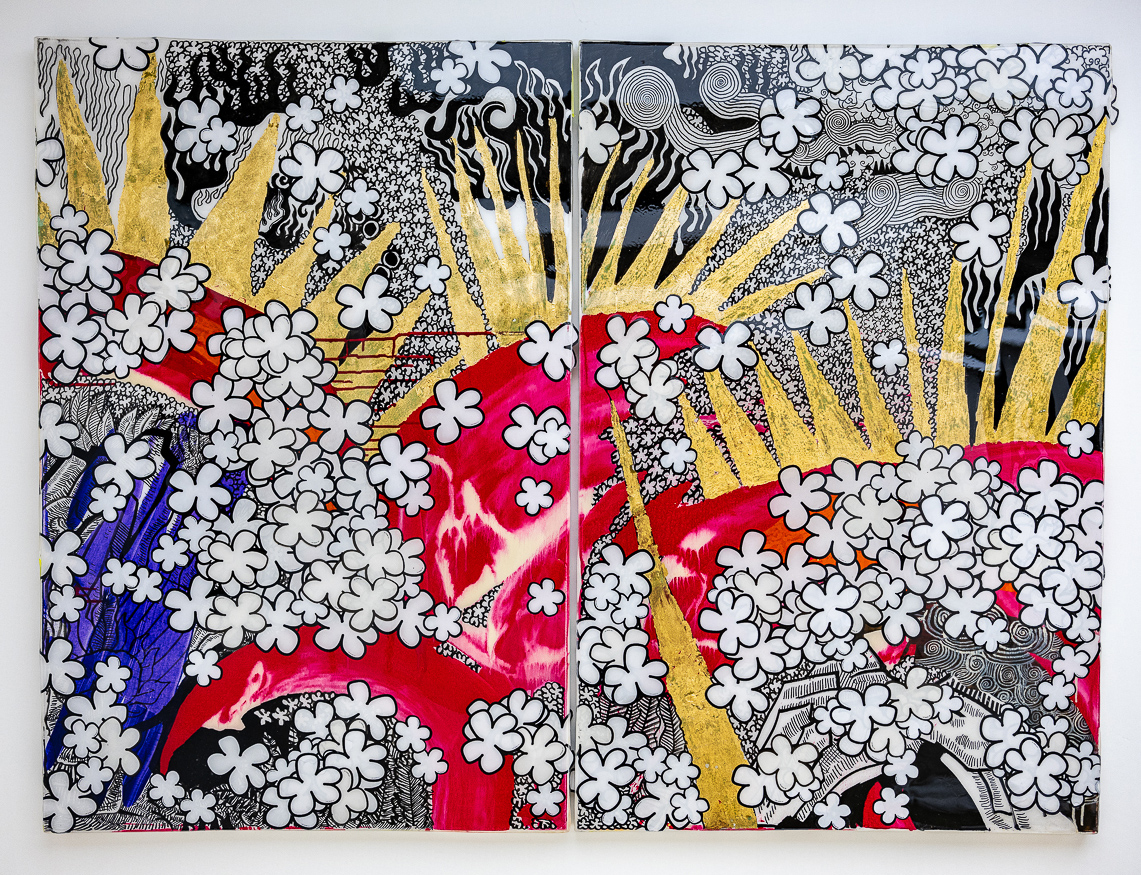
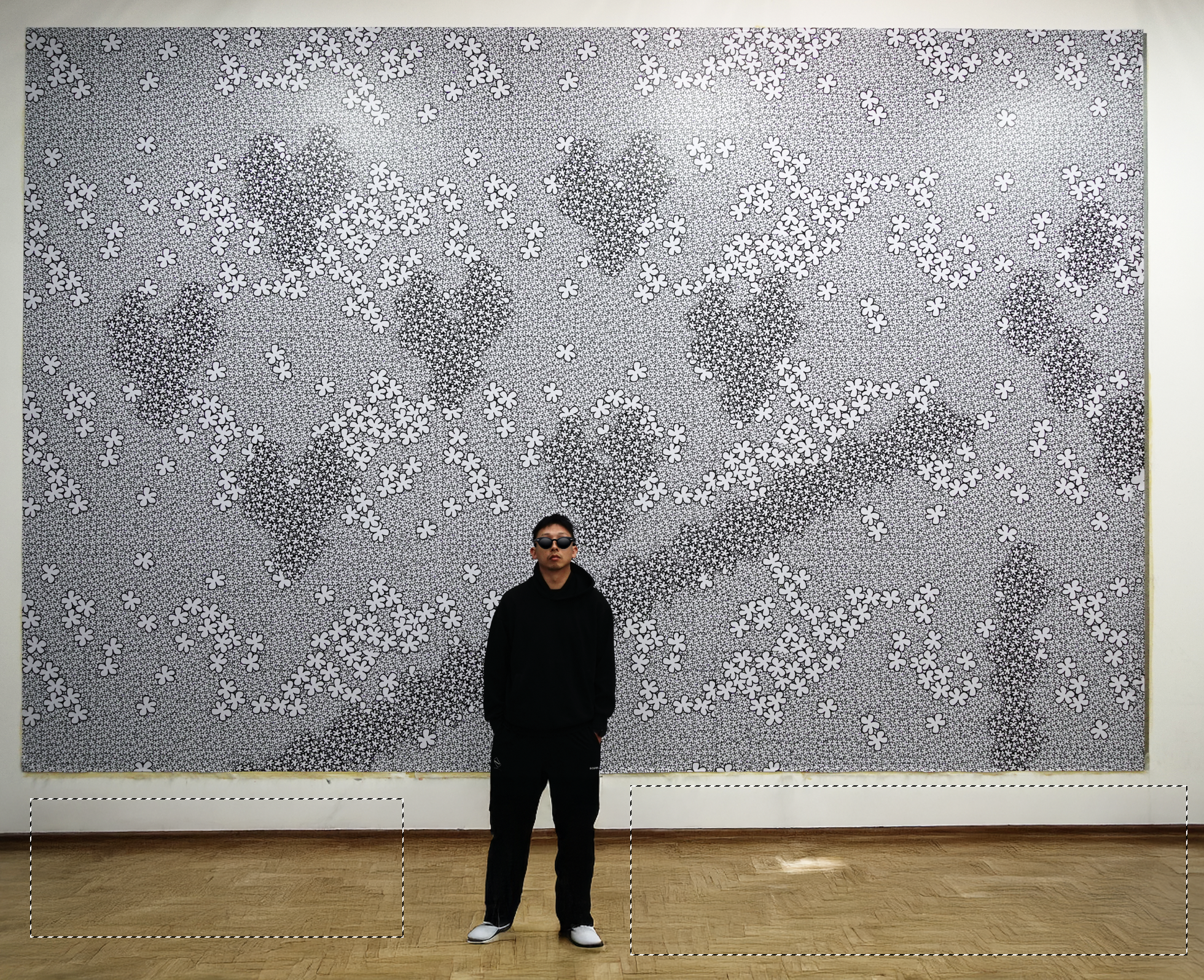
Lve Wang 重複出現的花卉實體、層疊表面、金屬碎片、塗鴉式筆觸、樹脂封存與堆積式視覺場,是對符號侵蝕進行減速的嘗試。他的符號不以完整的神話形象出現,它們是以碎片、殘渣、不斷返回的有機體形態浮現。這個區別至關重要。在 Dream Cells 裡,神話不是作為從傳統完整繼承的連貫敘事而存活,而是作為散落的細胞物質,在當代視覺混亂中試圖重新組織自己。
「細胞」這個結構在這裡格外有力。傳統的神話系統依賴連續性:重複的故事、穩定的原型、共享的宇宙觀。但當代生活由斷裂所定義——遷徙、平台資本主義、城市化、商業品牌、數位流通、政治分裂,已經中斷了許多集體符號系統。在這種條件下,神話無法以完整形態出現,它必須以局部形態存活。細胞因此既是隱喻也是方法:一個能在崩塌後變異、複製、存活的最小單位。
這讓 Dream Cells 變得不只是符號繪畫。這件作品開始作為後連續性文化的一種推測性神話而運作。
關鍵在於:王略的神話語言並非透過直接的敘事插圖運作。他不是用歷史復興主義的方式去畫古典中國神話中可辨識的場景。他從神話思維本身提煉結構性質——重複、變形、循環時間、靈性層次、符號變異、可見與不可見世界的並存。他的花卉實體不是固定的圖騰,它們更接近在不同物質與時間環境中遷移的有機體。
這個取徑呼應了當代全球藝術中的一個更廣泛趨勢:神話不再以歷史重演的方式出現,而是作為符號性的基礎設施。問題不再是「如何保存傳統」,而是:「文化碎片化之後,還有哪些符號生命形式是可能的?」
對許多非西方藝術家而言,這個問題額外承擔了政治重量。西方現代性歷史性地把非西方神話定位為原始的、裝飾性的、非理性的、人類學的。今天重新主張神話系統的藝術家,並不只是在復興文化母題,他們是在質疑那個讓西方理性主義自我加冕為普世知識與再現框架的階序。神話成為一種認識論的反抗。
王略的實踐在此獲得更廣的意義。他的作品提示我們:東方符號系統不能被簡化為文化遺產美學或身分品牌。它們作為記憶與感知的另一種技術運作。在 Dream Cells 裡,神話不是懷舊內容,而是重組現實的活躍方法。
重複的花卉結構在這個意義上特別關鍵。花在東亞視覺文化中歷史性地承擔了複雜的象徵功能:無常、季節更替、靈性精煉、死亡、情慾、宇宙平衡、文人退隱。但王略的花是不穩定的。它們被簡化為近乎童稚的記號,反覆層疊、覆蓋、碎裂、增殖、變形。透過這個過程,它們失去裝飾穩定性,成為符號持續性的承載物。
這種持續性之所以重要,是因為當代資本主義不斷把符號轉化為可消費表面。在品牌文化下,符號被剝離曖昧、被優化為可辨識。王略反覆出現的形態透過拒絕封閉來抵抗這種扁平化。它們從未完全收斂成 logo、吉祥物或固定敘事裝置,而是懸置在天真與變異、裝飾與傷口、記憶與消失之間。

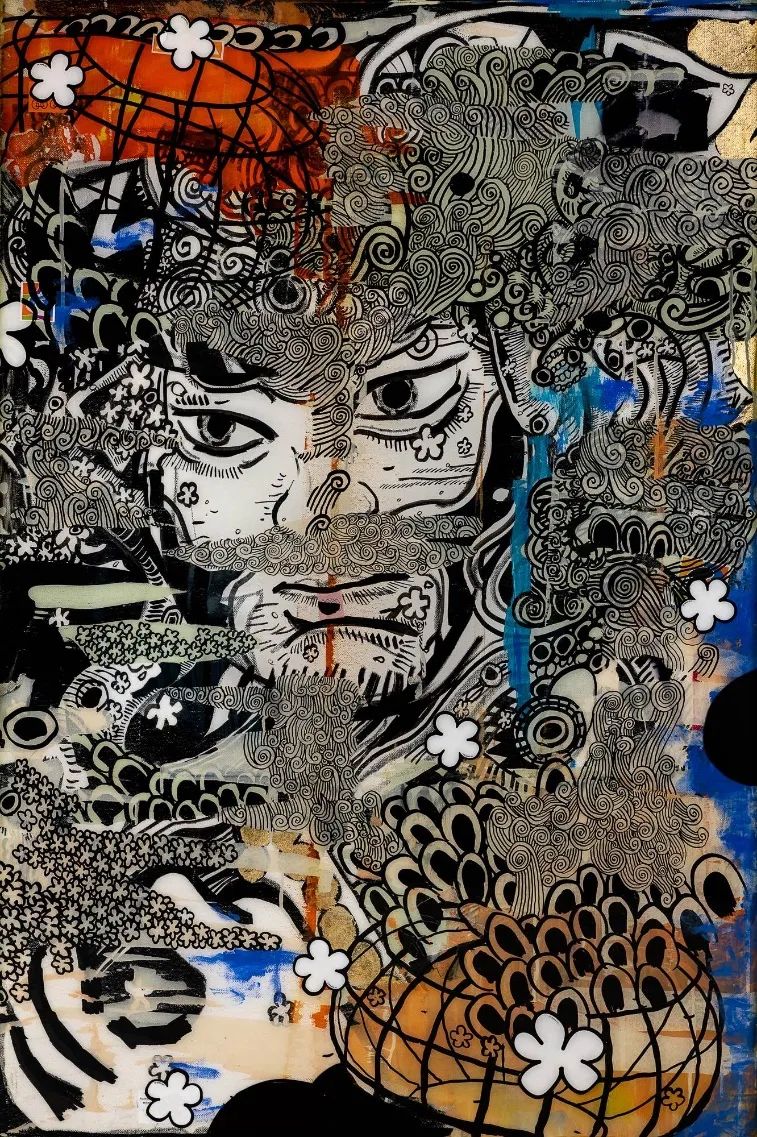
王略表面的物質構造強化了這個張力。金箔召喚神聖光照與儀式價值,卻與貼紙、塗鴉式堆積這些屬於城市瞬時性與非正式流通的符號並置。樹脂同時保存與困住影像,產生記憶與可達性之間的悖論。最終產生的是不相容時間並存的表面:儀式時間、數位時間、童年時間、城市時間、神話時間。
這場碰撞至關重要。Dream Cells 中的神話並不在現代性之外運作,它在受損的當代環境內部存活。王略因此避開了神話導向當代藝術經常陷入的浪漫主義——他不是逃進一個未被觸碰的靈性過去,而是堅持神話必須穿越技術飽和、商業圖像、城市殘片與碎片化記憶。
在這個意義上,他的作品與更廣泛的、在不穩定條件下重建符號系統的一代藝術家共享親緣。但他的特定貢獻在於:他把東方宇宙觀感性與後塗鴉視覺邏輯合而為一。塗鴉文化傳統上透過重複、標籤化、領地標記、匿名性與表面佔據運作;神話傳統上透過跨世代的符號傳遞運作。王略把這兩個系統壓進同一個系統裡。
結果是一個新的符號狀態:神話像城市殘片那樣運作。
這也許是 Dream Cells 最有說服力的一個面向。作品提示我們:今天的神話不再主要透過廟堂、經典或國家敘事存活,而是透過流通、碎片、表面、重複,以及在不穩定公共空間中留下的非正式痕跡存活。神聖不再以權威真理的形式從上方降臨,它從累積的視覺殘片中重新浮現。
這個位置的意義超出美學。在一個越來越被演算法預測、量化注意力與平台可見性所統治的世界裡,神話提供某種難以被優化的東西——曖昧、不透明、符號的過剩、非線性的時間。神話思維打斷了數位系統所要求的全面透明邏輯,它保留了不確定、集體投射與情感複雜性的空間。
正因如此,神話可以作為反抗運作。
不是那種簡化的、直接政治訊息的反抗,而是對符號同質化本身的反抗。對「文化被縮減為即時可消費內容」的反抗。對「共同符號深度在加速圖像經濟下消失」的反抗。
在 Dream Cells 裡,反抗不以對抗的姿態出現,而以堅持的形式出現。
重複的花存活下來。 受損的符號存活下來。 層疊的表面存活下來。 神話存活,正是因為它不斷變異。
這也是為什麼王略的作品不應只用「個人表達」的框架去讀。它更深的野心在別處:建構一個視覺生態系,讓碎片化的文化記憶可以在穩定敘事崩解之後,繼續生成符號生命。
在這個生態系裡,神話不再是來自過去的繼承故事。它成為一個用以在當下倖存的適應性結構。
Mythology as Resistance: Rewriting Cultural Memory Through Dream Cells
In contemporary art discourse, mythology has returned with unusual intensity. Yet its return is fundamentally different from the mythological revivalisms of the twentieth century. Myth today is no longer approached as a stable origin, a national essence, or a romantic escape into the past. Instead, mythology has become a contested terrain: a structure through which artists negotiate memory, colonial history, image circulation, technological acceleration, ecological anxiety, and the fragmentation of cultural identity under globalization. In this context, mythology is no longer simply inherited. It is reconstructed from debris.
This shift explains why contemporary curatorial interest in non-Western mythologies has expanded so dramatically over the past decade. Artists such as Bharti Kher, Chiharu Shiota, and Pacita Abad are not celebrated merely because they reference Asian cultural traditions. Their significance lies in how they reactivate mythological structures within conditions of displacement, migration, postcolonial tension, bodily fragility, and unstable collective memory. Myth, in these practices, ceases to function as folklore illustration. It becomes a mechanism of resistance against dominant visual systems.
Lve Wang’s Dream Cells can be understood within this emerging framework. His work should not be read as the construction of a private fantasy universe, nor as the aesthetic recycling of Eastern symbols for contemporary consumption. Rather, it can be positioned as a project of mythological reconstruction within an era of visual exhaustion. The significance of Dream Cells lies precisely in its attempt to rebuild symbolic meaning after the collapse of stable cultural narratives.
Contemporary image culture is structurally hostile to mythology. Digital platforms accelerate circulation while flattening symbolic depth. Images are optimized for immediacy, visibility, and algorithmic recognition. Under these conditions, symbols lose duration. They no longer accumulate sacred, communal, or historical meaning over time. Instead, they become rapidly exchangeable visual units detached from origin, ritual, and place. The contemporary image economy does not destroy myth through censorship; it dissolves myth through speed.
This is the cultural condition against which Dream Cells operates.
Lve Wang’s repeated floral entities, layered surfaces, metallic fragments, graffiti-derived marks, resin encapsulations, and accumulative visual fields function as attempts to slow symbolic erosion. His symbols do not appear as complete mythological figures. They emerge instead as fragments, residues, recurring organisms. This distinction is critical. In Dream Cells, mythology does not survive as a coherent narrative inherited intact from tradition. It survives as scattered cellular matter attempting to reorganize itself within contemporary visual chaos.
The “cell” becomes an especially powerful structure in this regard. A mythological system traditionally depends upon continuity: repeated stories, stable archetypes, shared cosmologies. But contemporary life is marked by discontinuity. Migration, platform capitalism, urbanization, commercial branding, digital circulation, and political fragmentation have interrupted many collective symbolic systems. Under such conditions, mythology can no longer appear whole. It must survive in partial forms. The cell therefore becomes both metaphor and method: a minimal unit capable of mutation, reproduction, and survival after collapse.
This transforms Dream Cells into something more than symbolic painting. The work begins to function as a speculative mythology for post-continuity culture.
Importantly, Wang’s mythological language does not operate through direct narrative illustration. He does not paint identifiable scenes from classical Chinese mythology in the manner of historical revivalism. Instead, he extracts structural qualities from mythological thinking itself: repetition, transformation, cyclical temporality, spiritual layering, symbolic mutation, and the coexistence of visible and invisible worlds. His floral entities are not fixed icons. They behave more like evolving organisms crossing different material and temporal environments.
This approach aligns with a broader tendency in contemporary global art, where mythology increasingly appears not as historical reenactment but as symbolic infrastructure. The question is no longer “How do we preserve tradition?” but rather: “What forms of symbolic life remain possible after cultural fragmentation?”
For many non-Western artists, this question carries additional political weight. Western modernity historically positioned non-Western mythologies as primitive, decorative, irrational, or ethnographic. Contemporary artists reclaiming mythological systems are therefore not simply reviving cultural motifs. They are contesting the hierarchy through which Western rationalism established itself as the universal framework of knowledge and representation. Mythology becomes a form of epistemological resistance.
This is where Wang’s practice gains broader significance. His work suggests that Eastern symbolic systems cannot be reduced to heritage aesthetics or identity branding. Instead, they function as alternative technologies of memory and perception. In Dream Cells, mythology is not nostalgic content. It is an active method for reorganizing reality.
The repeated floral structures are particularly important in this regard. Flowers in East Asian visual culture have historically carried complex symbolic functions: impermanence, seasonal transition, spiritual refinement, mortality, eroticism, cosmological balance, and scholarly withdrawal. But Wang’s flowers are unstable. They are simplified into almost childlike signs, repeatedly layered, covered, fragmented, multiplied, and transformed. Through this process, they lose ornamental stability and become carriers of symbolic persistence.
This persistence matters because contemporary capitalism continuously converts symbols into consumable surfaces. Under branding culture, symbols are stripped of ambiguity and optimized for recognition. Wang’s repeated forms resist this flattening by refusing closure. They are never fully resolved into logos, mascots, or fixed narrative devices. Instead, they remain suspended between innocence and mutation, decoration and wound, memory and disappearance.
The material construction of Wang’s surfaces intensifies this tension. Gold leaf invokes sacred illumination and ritual value, yet appears alongside stickers and graffiti-like accumulations associated with urban transience and informal circulation. Resin simultaneously preserves and entraps imagery, producing a paradoxical relationship between memory and accessibility. The result is a surface where incompatible temporalities collide: ritual time, digital time, childhood time, urban time, mythological time.
This collision is crucial. Mythology in Dream Cells does not function outside modernity. It survives inside damaged contemporary environments. Wang’s work therefore avoids the romanticism that often weakens myth-based contemporary art. Rather than escaping into an untouched spiritual past, Dream Cells insists that mythology must pass through technological saturation, commercial imagery, urban debris, and fragmented memory.
In this sense, Wang’s work shares affinities with a broader generation of artists reconstructing symbolic systems under conditions of instability. However, his specific contribution lies in how he merges Eastern cosmological sensibilities with post-graffiti visual logic. Graffiti culture traditionally operates through repetition, tagging, territorial marking, anonymity, and surface occupation. Mythology traditionally operates through symbolic transmission across generations. Wang collapses these two systems together.
The result is a new symbolic condition: mythology behaving like urban residue.
This is perhaps the most compelling dimension of Dream Cells. The work proposes that mythology today no longer survives primarily through temples, scriptures, or state narratives. It survives through circulation, fragments, surfaces, repetitions, and informal marks left within unstable public space. The sacred no longer descends from above as authoritative truth. It re-emerges from accumulated visual debris.
Such a position carries implications beyond aesthetics. In a world increasingly governed by algorithmic prediction, quantified attention, and platform visibility, mythology offers something difficult to optimize: ambiguity, opacity, symbolic excess, and nonlinear time. Mythological thinking disrupts the logic of total transparency demanded by digital systems. It preserves spaces for uncertainty, collective projection, and emotional complexity.
For this reason, mythology can function as resistance.
Not resistance in the simplistic sense of direct political messaging, but resistance against symbolic homogenization itself. Resistance against the reduction of culture into instantly consumable content. Resistance against the disappearance of communal symbolic depth under accelerated image economies.
Within Dream Cells, resistance does not appear as confrontation. It appears as persistence.
The repeated flower survives.
The damaged symbol survives.
The layered surface survives.
The myth survives precisely because it mutates.
This is why Wang’s work should not be interpreted merely through the framework of personal expression. Its deeper ambition lies elsewhere: in constructing a visual ecosystem where fragmented cultural memory can continue generating symbolic life after the collapse of stable narratives.
In this ecosystem, mythology is no longer an inherited story from the past. It becomes an adaptive structure for surviving the present.